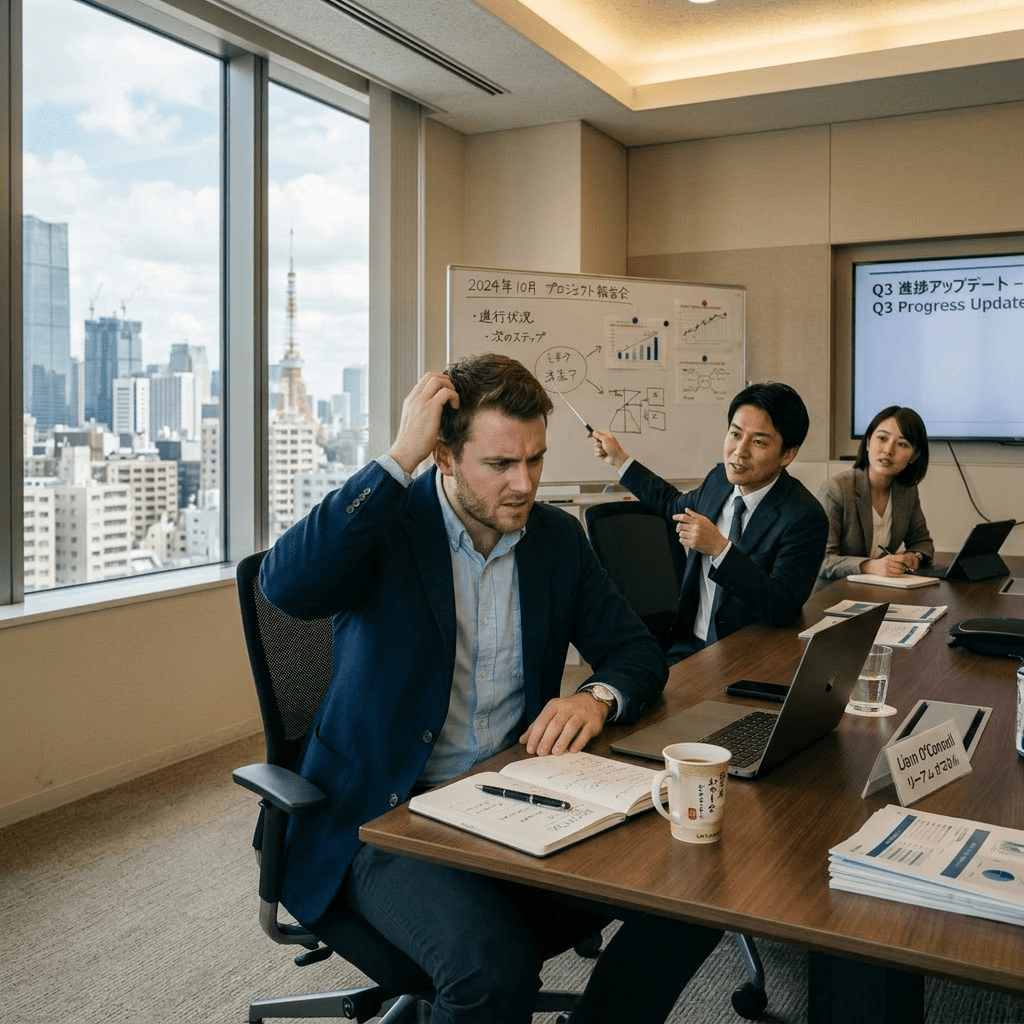
Moving and working in Japan comes with many adjustments. Some of them will even shape your personality over time.
People talk about this often, but not always in detail.
While some Japanese companies are starting to adopt more Western ways of working, this is still not the norm. If you are planning to move here, you need to understand this early.
If you don’t, the gap between expectation and reality can be frustrating.
Communication
Japan is known for being polite and non-confrontational. This carries directly into the workplace.
Communication is often:
- Indirect
- Implicit
- Based on reading between the lines
This is very different from Western environments, where people are encouraged to be direct and say what they mean.
In Japan, many workplace behaviors are learned early, often from the moment someone enters the workforce as a fresh graduate. If you did not grow up in this system, you will need to learn it as you go.
For example:
If a colleague says,
“It’s nice, but I would do it this way,”
they are not just sharing an opinion. They are telling you to adjust your work.
If your manager says,
“Your clothing is very colorful,”
they are likely not complimenting you. They are signaling that you may not be matching expectations.
This is where “reading the room” becomes critical.
If you rely only on direct words, you may miss the message. Over time, this can lead to being seen as someone who doesn’t quite understand how things work.
There is also a growing focus on workplace behavior due to stricter rules around harassment. This applies in all directions, including how employees communicate with managers.
So tone, timing, and wording matter more than you might expect.
Feedback
Feedback in Japan can be difficult to interpret.
It is often:
- Soft
- Subtle
- Not clearly stated
In some cases, you may not receive direct feedback at all.
This can be challenging, especially if you are used to environments where feedback is frequent and clear. Without it, you may feel unsure about your performance, whether things are going well or not.
That ambiguity can be uncomfortable.
But once you understand how feedback is given, you can start to pick up signals and adjust.
If you are in a management role, this becomes even more important.
Direct feedback, which is common in Western companies, can sometimes feel too strong or aggressive in a Japanese context. Adjusting your tone and delivery will help you build trust with your team.
Decision-Making
Many people assume Japan is a top-down, hierarchical culture.
In reality, harmony plays a bigger role.
Decisions are often:
- Consensus-driven
- Slow
- Involving multiple stakeholders
Before a decision is made, there is usually a process of alignment behind the scenes.
This is known as “nemawashi.”
It means preparing the ground before making a decision.
Instead of debating in a meeting, you speak with stakeholders individually, share your idea, and gather support. By the time the meeting happens, the decision is already aligned.
The meeting itself becomes a confirmation, not a discussion.
This can feel slow at first, but it helps avoid open conflict and keeps the team aligned.
Hierarchy
Hierarchy is strong in Japan, and seniority carries weight.
If someone more senior shares an opinion, challenging them directly is not common.
This does not mean you cannot influence decisions.
But the approach matters.
Instead of pushing directly, you guide the conversation. You create space for your idea to be accepted rather than forcing it.
Maintaining harmony and allowing others to “save face” is important.
If you are too direct, even with good intentions, it can damage relationships.
Meetings
Meetings in Japan work differently.
They are usually not a place for debate.
By the time a meeting happens, most of the alignment has already been done through nemawashi.
If you disagree strongly during the meeting, it may be seen as disrupting harmony rather than contributing.
Meetings can also be longer than what you may be used to.
And one important detail:
If a meeting starts at 9:00, you are expected to be there before 9:00.
Arriving at exactly 9:00 is often considered late.
Work Hours
There have been many changes in recent years, and the government has taken steps to reduce extreme working conditions.
Still, perception matters.
In some environments:
- Staying longer can be seen as commitment
- Leaving earlier than your manager may feel uncomfortable
This is not always the case, but it depends heavily on your team and your manager.
The best approach is to observe:
- How your colleagues behave
- When people leave
- How your manager views working hours
And when you do leave, don’t forget the small things.
A simple “osakini shitsureishimasu” goes a long way.
Final Thought
In Japan, maintaining harmony is not just a skill. It is an expectation.
This applies to:
- Your manager
- Your colleagues
- Your team as a whole
If you are driving projects or aiming for growth, understanding this will make a big difference in how you are perceived and how effective you can be.
Continues in Part 2…
 Japan Career Lab
Leave a comment